ABS is a common choice for machined housings, enclosures, brackets, and prototypes. ABS CNC machining may be a good fit, but parts with close-fitting features, sustained loads, or heat exposure need a closer material review. Stock grade, geometry, appearance requirements, and production quantity can also affect the manufacturing choice. This article looks at where ABS works well, what can go wrong during machining, and when 3D printing, vacuum casting, or a different plastic may be a better fit.
ABS Plastic for CNC Machining: Properties and Available Colors
ABS is often chosen for parts that may be dropped, bumped, or handled repeatedly but do not need the stiffness of a metal component. Its relatively low density also helps when a cover or enclosure needs to stay lightweight. As a broad material reference, the British Plastics Federation lists ABS density at 1.0–1.05 g/cm³; the exact value for a project should come from the grade being purchased.
The balance between toughness, stiffness, and heat resistance is not fixed. Higher-impact ABS grades are available when resistance to knocks is the priority; higher-heat grades address a different requirement. Flame-retardant formulations are another option when flame-retardant performance is required. These labels describe the property being targeted, not a promise that every property improves at once. Compare the proposed grade’s test results with the actual loads and operating conditions.
Standard ABS is easier to justify for parts used at ordinary ambient temperatures than for components that must remain stiff under sustained heat. Chemical contact also needs to be defined: a brief wipe with a cleaner is not the same exposure as continuous contact with a solvent. Moisture uptake is generally lower than for common nylon grades, but dimensional fit can still be affected by temperature and material condition. Where electrical insulation matters, check the selected grade’s data.
For appearance, ask what color is available in the required grade. Natural, black, and white are practical starting points, but a color offered for one ABS product may not be offered for another. If a visible face must match an existing assembly, confirm the stock color and surface specification before finalizing the drawing.

When Should You Use ABS for a CNC Machined Part?
An enclosure cover, equipment bezel, or electronics housing that needs to tolerate routine handling without carrying a major structural load is a plausible ABS candidate. The same applies to a lightweight fixture or robotics cover where a nonconductive body and a presentable surface are useful. For a functional prototype, machining from ABS stock can let the team evaluate assembly, access, and handling in the intended material before committing to another production route.
Brackets and automation components need a closer look. An ABS bracket may suit a modest load, but the decision depends on its span, wall sections, fastening points, and duration of loading. For low-volume custom production, straightforward geometry and no need for a molded appearance can make machining practical. A cover with broad, accessible faces is a different proposition from one whose function depends on hidden passages or intricate internal features.
Treat ABS as a weaker candidate when the limiting requirement is sustained high temperature, demanding sliding wear, high structural load, or very high stiffness. It also deserves scrutiny where long-term fit is critical across changing conditions, or where aggressive chemicals contact the part. For example, if an enclosure sits beside a heat source and its latch alignment must remain consistent, assess the operating temperature and loaded features before selecting ABS.
CNC Machining ABS: Common Problems and Practical Tips
Heat and smearing. A cutter that rubs rather than shears can generate enough local heat to soften ABS. Chips may smear across the surface or stick to the tool, causing more rubbing on the next pass. Use a sharp tool and choose spindle speed and feed to maintain an appropriate chip load without overloading the cutter. Clear chips so they are not cut repeatedly; an air blast can help where it is appropriate for the setup. Inspect the cutting edge if the surface begins to look dragged or glossy rather than cleanly cut. A light finishing pass can improve the result, provided it still cuts instead of rubbing.
Tool diameter, flute geometry, machine behavior, workholding, part geometry, and material condition all affect the workable settings. Single-flute or O-flute cutters can provide chip clearance in suitable milling ABS plastic operations, but geometry should be selected for the actual cut.
Burrs and rough edges. A dull edge can push material instead of cutting it, leaving raised edges around profiles, slots, or holes. Check tool condition, chip removal, and how the tool enters and exits the feature. A controlled finishing pass may clean the edge; simply adding more passes will not help if they create heat or rub the same material. Plan accessible edges for subsequent deburring.
Deformation under the tool or fixture. Thin walls may deflect during cutting, while excessive clamping force can distort a blank before it is machined. Once released, the part may no longer match the dimensions measured in the fixture. Support thin sections, use appropriate workholding, and avoid gripping a compliant feature harder than necessary. Where substantial material must be removed, leave enough support for later operations instead of exposing delicate walls early.
Dimensional variation. Heat, flexible geometry, stock condition, clamping, and machining sequence can each affect the finished size. Removing material unevenly may also release stress in the stock. For fit-critical features, plan a roughing and finishing sequence, allow the part to return to a consistent condition before final measurement, and specify the dimensions that actually control assembly. The aim in machining ABS plastic is to control heat and support the part throughout the operation.
Common Surface Finishes for CNC Machined ABS Parts
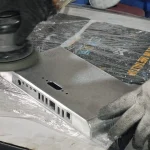
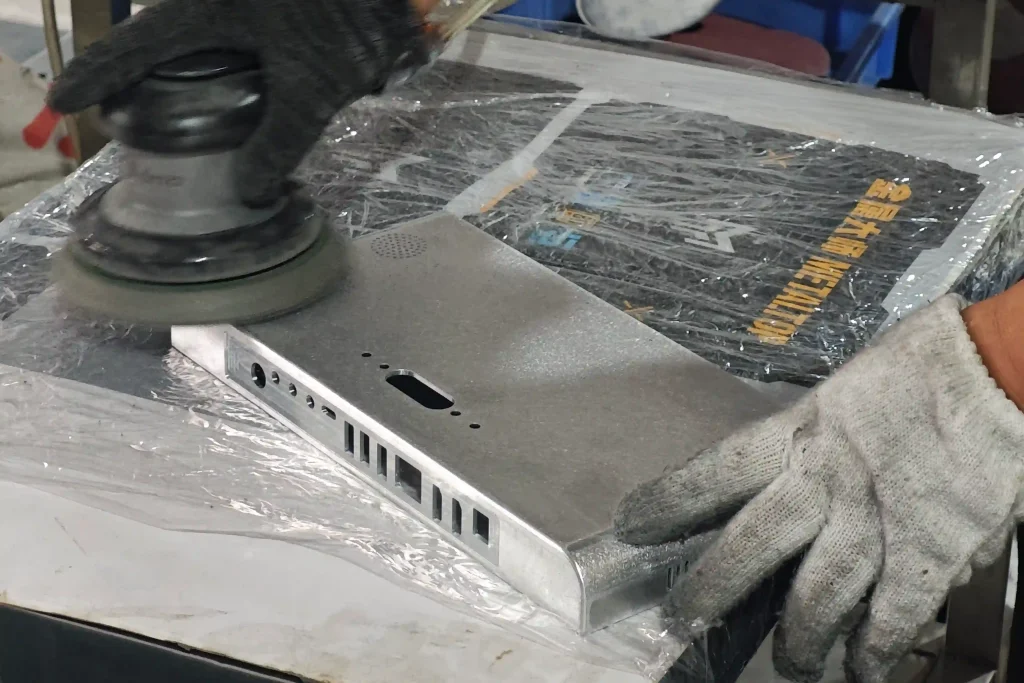
An as-machined surface is often sufficient for an internal fixture or functional prototype. It avoids an extra finishing step, but visible tool marks may remain. Deburring removes raised edges that could interfere with handling or assembly. For exposed faces, careful sanding can reduce tool marks and establish a more even texture; polishing may be appropriate for selected cosmetic areas, depending on the grade and desired appearance.
Painting can provide a specified color or more uniform visual finish, subject to coating compatibility and surface preparation. Printing or labeling can add part numbers, alignment marks, or interface graphics without changing the entire surface. Agree on a sample if appearance matters: “smooth” can mean different things to a machinist and a product designer.
Finishing can change surface texture and dimensions. Sanding removes material, while paint adds a coating; either can affect a close-fitting interface. Identify mating faces, holes, and other critical dimensions before finishing, and state whether their tolerances apply to the machined or finished part.

ABS CNC Machining vs. 3D Printing vs. Vacuum Casting
The table compares CNC machining from ABS stock, filament-based ABS 3D printing, and vacuum casting with an ABS-like polyurethane resin. The resulting parts should not be assumed to have the same material properties.
| Criterion | Machined ABS | 3D-printed ABS | Vacuum-cast ABS-like resin |
| Dimensional accuracy | Good potential on accessible features; setup-dependent | Process-, orientation-, and feature-dependent | Process-dependent; influenced by master, mold, and shrinkage |
| Surface finish | Machined finish; tool marks may show | Layer texture may show; post-processing available | Can replicate a molded-like master surface |
| Geometric freedom | Limited by cutter access and fixturing | High for complex or internal geometry | Can replicate suitable moldable geometry |
| Functional prototype | Suitable when machined stock behavior matters | Suitable when printed-part behavior is acceptable | Suitable if the chosen resin meets test needs |
| Appearance prototype | Suitable, with finishing as needed | Suitable, often with post-processing | Suitable for repeated cosmetic samples |
| Production quantity | Prototypes and low-volume parts | Very small quantities and iterations | Multiple low-volume copies |
| Tooling requirement | Cutting tools and workholding; no mold | Printer and any required supports; no mold | Master pattern and silicone mold |
| Material behavior | Properties of the specified ABS stock | Depends on filament, build orientation, and print settings | Properties of the selected casting resin, not stock ABS |
| Repeatability | Depends on stock, setup, and inspection | Depends on print control and orientation | Depends on master, resin, and mold condition |
For a prototype with critical mating features, CNC machining from specified ABS stock is often the most direct way to check fit and function in that material. The geometry still has to be accessible to cutting tools, and each part requires machining and workholding. Deep enclosed cavities or features the cutter cannot reach may make the approach impractical.

If the design is still moving, material matching may be less important than getting the geometry right. Filament-based ABS printing allows rapid one-off iterations and can produce features that would be awkward to cut. Its mechanical response depends on print orientation and layer bonding, though, so a printed load test should not be assumed to predict the behavior of machined stock.
Once the design is reasonably settled, vacuum casting can produce several similar prototypes from a master and silicone mold, often with a molded-like surface. The mold takes additional work to make, so it is less compelling for a single part. An “ABS-like” casting resin is not the same material as ABS stock; check its data before relying on cast parts for functional validation. Larger production volumes may justify assessing injection molding.
For a broader comparison of prototype processes, see our rapid prototyping page.

ABS Alternatives: PC-ABS, PC, Nylon, or POM?
Heat, repeated impact, and sliding wear can each rule out ABS for a different reason. For example, Nylon may be a better fit for loaded or wear-prone parts, while ABS is often used for housings, covers, and functional prototypes. For a closer comparison, see our guide to Nylon vs ABS.
| Material | Consider it when… |
| ABS | The part is primarily a housing, cover, or prototype with moderate loads and an appearance requirement. |
| PC-ABS | A housing needs more impact or heat performance than the proposed ABS grade provides. |
| PC | Impact or operating temperature is the main reason to move away from ABS; check chemical exposure as well. |
| Nylon | The part has become more of a loaded or wear-prone mechanical component than a cosmetic cover; allow for moisture-related changes. |
| POM (acetal) | The part slides against another surface and low friction, wear, or consistent fit matters more than appearance. |
A sliding guide, for instance, calls for a different review than a cosmetic housing. Conversely, selecting a stronger material does little for a part whose real risk is chemical exposure or an unstable fit. Choose the material based on the property that limits the part, then check the available grade against the service conditions.
Conclusion
A well-machined ABS part still has to work in its intended environment. Check the features that carry load, the temperatures the part will see, and the dimensions that control assembly. FastPreci can review your CAD model and drawing if you need a second look at the material choice or machining plan.
ABS CNC Machining FAQ
Can ABS be CNC machined for a functional prototype?
Yes. Machining from ABS stock is useful when the prototype needs to represent the intended material as well as the final geometry. You can check fit, fastener locations, and how the part behaves during handling. For loaded or heat-exposed features, use tests that reflect the actual operating conditions.
Why does ABS melt or smear during machining?
Local cutting heat can soften ABS, particularly when the tool rubs, chips accumulate, or a worn edge stops shearing cleanly. Sharp tooling, an appropriate chip load, effective chip evacuation, and a suitable finishing pass help reduce the risk. Adjust settings for the specific tool, geometry, and setup.
Is machined ABS stronger than 3D-printed ABS?
The two processes produce parts with different structural characteristics. Machined ABS retains the properties of the specified solid stock, while FDM-printed ABS can show direction-dependent strength because of layer bonding and print orientation. For mounting tabs, brackets, or snap features, consider the expected load direction before using a printed part as the strength test.
Can a CNC machined ABS part be painted?
Painting is an option for a specified color or more uniform cosmetic appearance, provided the coating and preparation suit the selected ABS grade. State which surfaces are cosmetic and which must fit other parts. Coating buildup can affect close-fitting features, so define critical dimensions on the finished part where that is what assembly requires.
Should I use ABS or polycarbonate for a CNC-machined enclosure?
ABS is a practical starting point for an indoor enclosure with moderate impact and temperature demands. Consider PC when greater impact resistance or heat performance is required. PC-ABS is also worth evaluating if neither material offers the balance you need. Check the selected material against operating conditions and any exposure to cleaners or solvents.
Can CNC-machined ABS be used outdoors?
Yes, but prolonged sunlight is a concern for standard ABS, particularly when the part must retain its color and appearance. For a permanently exposed housing, ASA may be a better material to evaluate. If ABS is specified, confirm that the selected grade or protective finish meets the project’s weathering requirements.