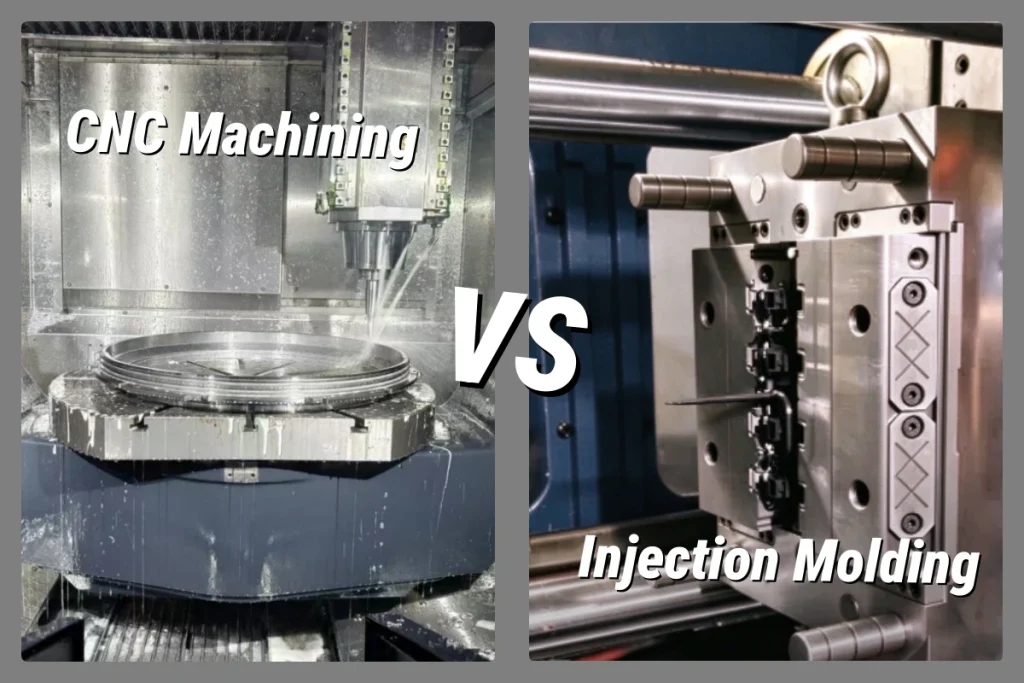
CNC machining avoids dedicated injection mold tooling, making it useful for prototypes, design changes, and small production batches. Injection molding requires more upfront work but can reduce the cost of producing the same part repeatedly.
This guide compares CNC machining vs injection molding by cost, lead time, materials, and design requirements. It focuses on the decisions that affect a real project: whether the material meets the application, whether the geometry suits the process, and whether the design is ready for tooling.
How CNC Machining and Injection Molding Work
How CNC Machining Removes Material
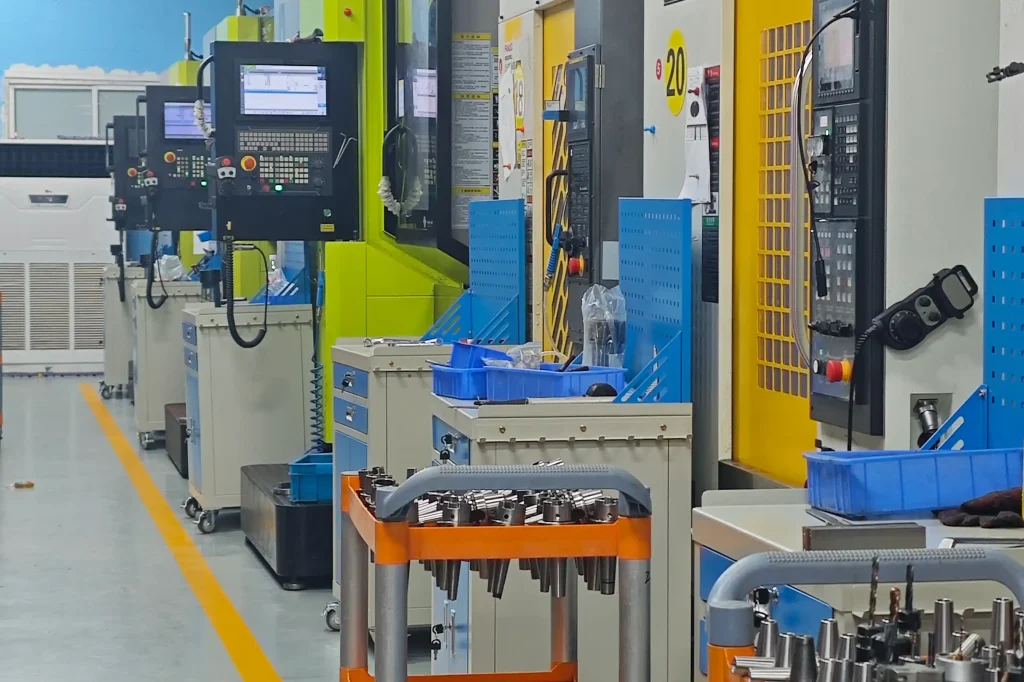
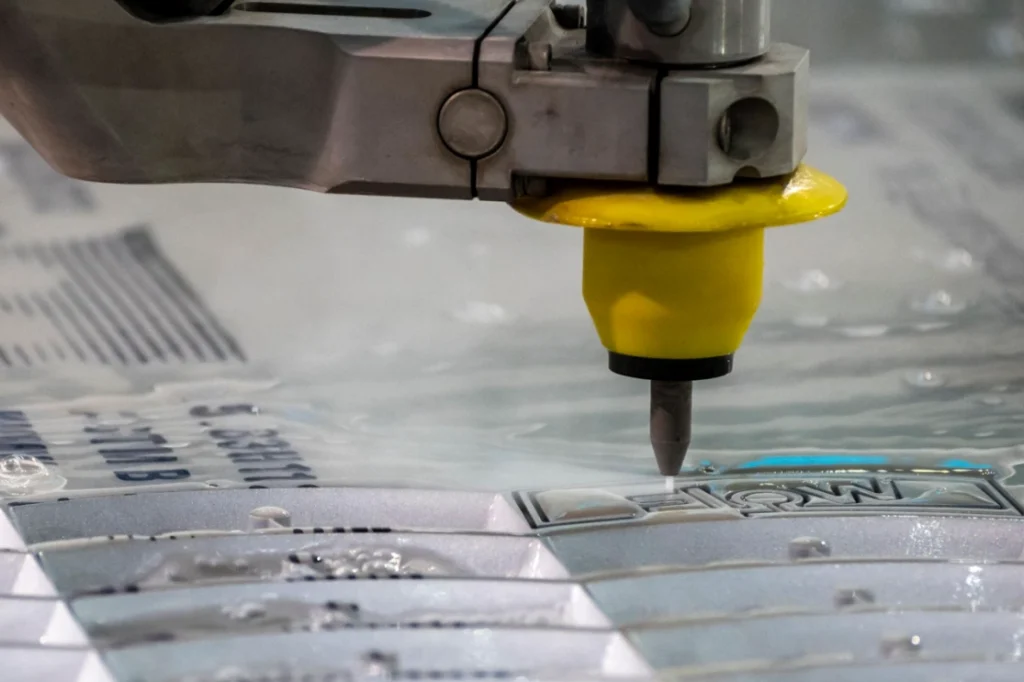
CNC machining is subtractive manufacturing: cutting tools remove material from solid stock according to programmed toolpaths developed from CAD/CAM data. Milling creates pockets, faces, and holes; turning efficiently produces rotational features. Both metals and machinable plastics are suitable.
Directly cutting functional features makes CNC useful for precision interfaces, prototypes, and low-volume production. Its constraints include material waste, cutter accessibility, workholding, and setup requirements. Deep cavities or features requiring repeated repositioning can increase machining time and unit cost.
How Injection Molding Forms Parts
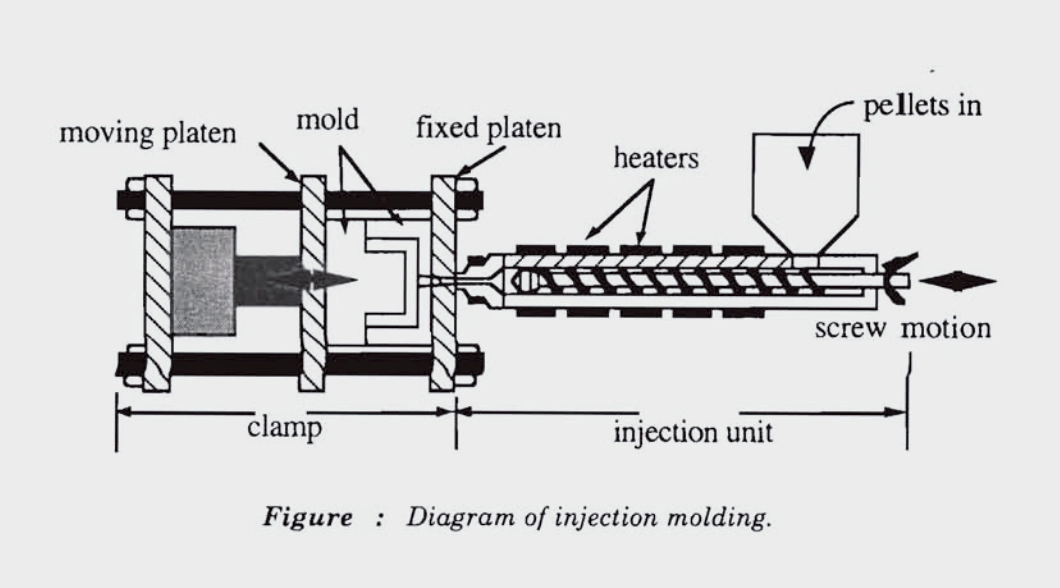 Injection molding injects molten thermoplastic into a mold cavity, where it cools, solidifies, and is ejected. The mold defines the geometry, so production requires upfront tooling design, manufacture, sampling, and approval. The basic molding sequence includes injecting resin, cooling the part, opening the mold, and ejecting the finished part.
Once validated, repeated cycles produce consistent parts without individually cutting every feature. That repetition supports economical production at scale. However, a short molding cycle says little about the time needed to develop tooling and obtain the first acceptable part.
CNC Machining vs Injection Molding: Key Differences
The table below highlights the differences that matter when choosing a manufacturing process.
| Factor | CNC machining | Injection molding |
| Manufacturing principle | Removes stock | Forms resin inside tooling |
| Upfront tooling investment | No dedicated mold required | Dedicated mold required |
| Standard tolerance | ±0.125 mm | ±0.250 mm |
| Typical lead time | Often 3 days to a few weeks | Initial parts often take a few weeks due to mold fabrication and trial molding |
| Material options | Metals, plastics, composites, and ceramics | Thermoplastics such as ABS, PP, PC, and nylon |
| Geometry constraints | Cutter access and workholding | Filling, core withdrawal, ejection |
| Surface finish | Toolmarks or secondary finishing | Mold-cavity polish or texture |
| Design changes | Revise program and setup | May require tool modification |
| Production quantity | Prototypes and low-volume runs are common applications | Prototypes and low-volume runs are common applications |
Cost Comparison: When Does Injection Molding Become Cheaper?
Upfront Tooling Cost vs CNC Setup Cost
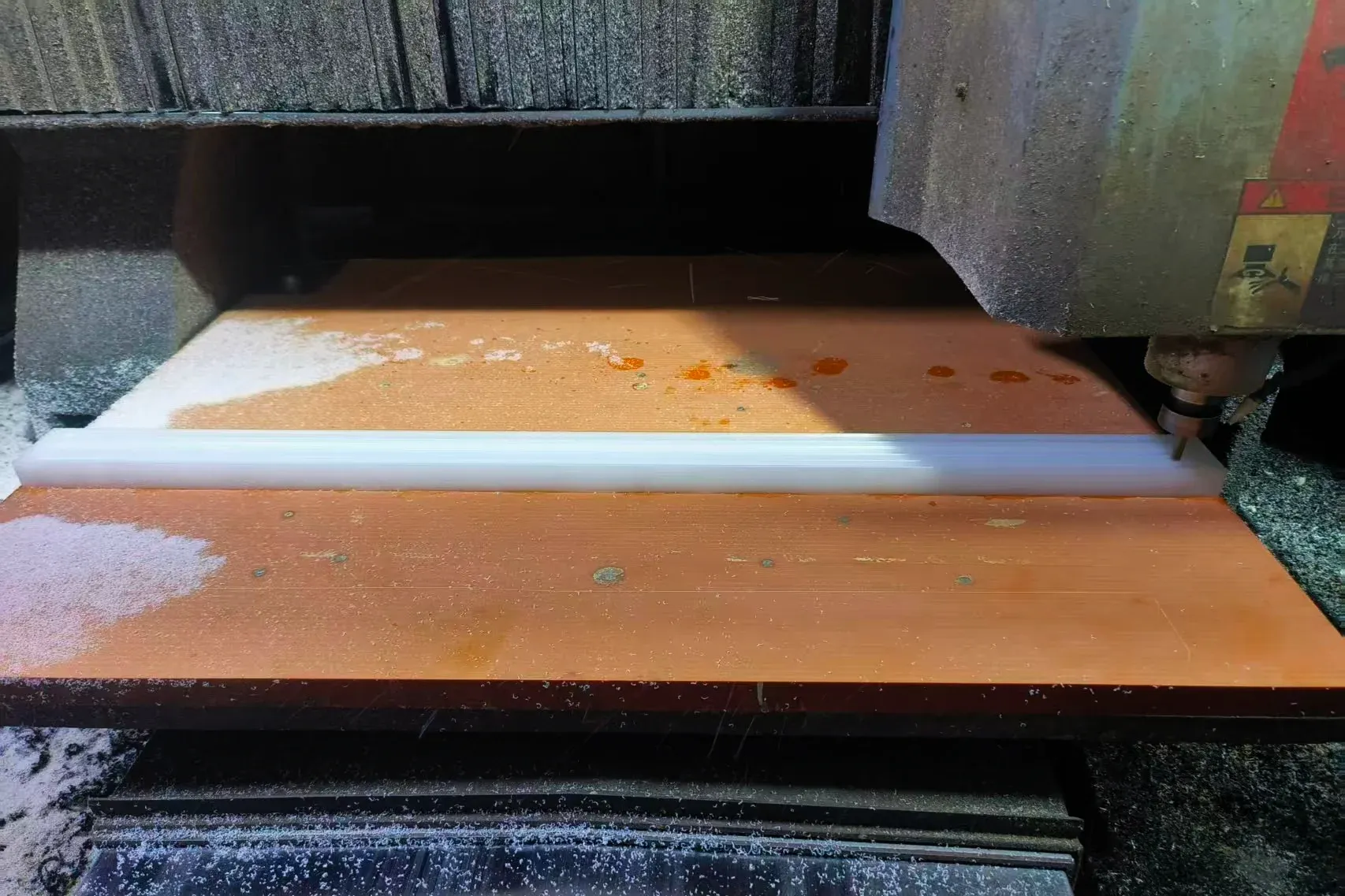
CNC machining avoids dedicated mold tooling, but still requires programming, workholding, material, machining, inspection, and finishing. Hard-to-reach features and tight tolerances can add cost.
Injection molding requires mold design and manufacture, followed by recurring costs for resin, machine time, inspection, and secondary operations. Ask suppliers to quote tooling separately from production.
Aluminum molds can suit prototypes and lower-volume production, while steel molds may be preferred for longer service life or demanding applications. The choice depends on resin abrasiveness, tool complexity, dimensional requirements, and expected shot count, not quantity alone.
How Production Volume Changes Cost per Part
Compare total costs using:
- Total CNC cost = CNC setup costs + quantity × CNC unit cost.
- Total molding cost = mold cost + molding setup costs + quantity × molding unit cost.
The break-even quantity is where these totals match for parts meeting the same requirements. Below that point, molding’s lower unit cost has not yet recovered the tooling investment.
CNC often suits one-offs, changing designs, and small batches. Molding becomes more attractive as a stable design generates repeat orders, although low-volume molding may still be justified when production-intent resin or molded features are essential.
For uncertain or intermediate volumes, compare actual quotations at several order quantities. Include finishing, inspection, scrap, mold maintenance, and expected tool life. Check a lower-demand scenario as well: tooling savings depend on orders materializing before the design changes.
Lead Time: First Article vs Production Runs
CNC machining often shortens initial prototype lead time by eliminating mold development. Injection molding adds mold design, manufacture, and trial runs before production approval. Both processes require inspection and may need adjustments after the first parts are evaluated.
Once tooling and process settings are validated, molding can produce repeat batches faster. Existing tooling removes mold development from repeat orders, but material procurement, machine scheduling, setup, and inspection still affect delivery.
For either process, request separate dates for first-article inspection, approval, and batch shipment. This makes schedules comparable and shows where customer approval is needed before production can proceed.
Materials and Part Design Differences
Material Compatibility

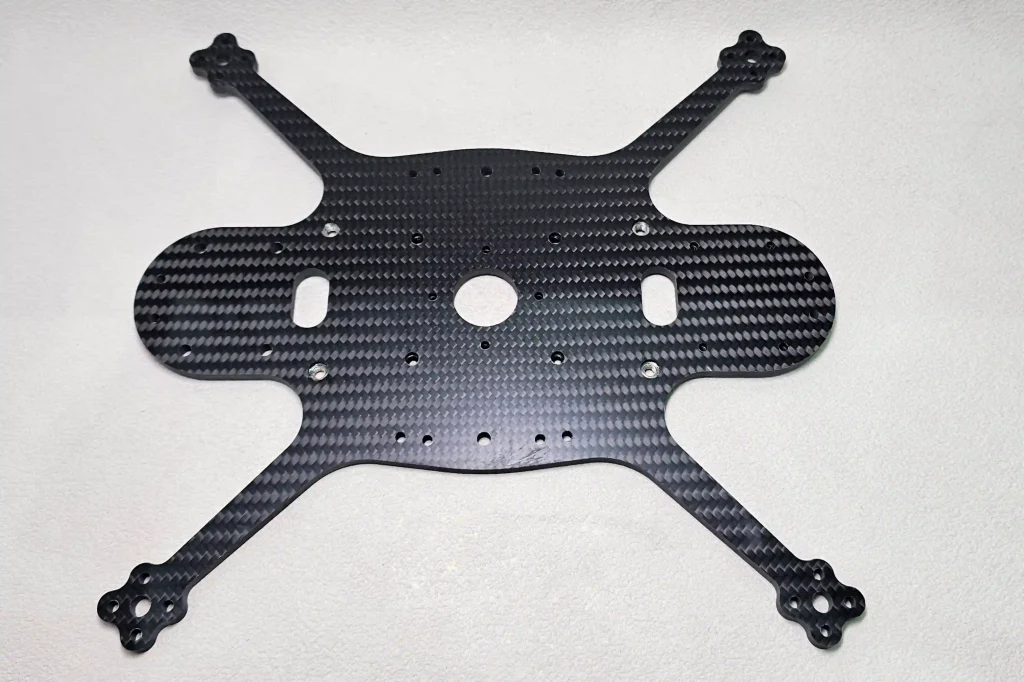
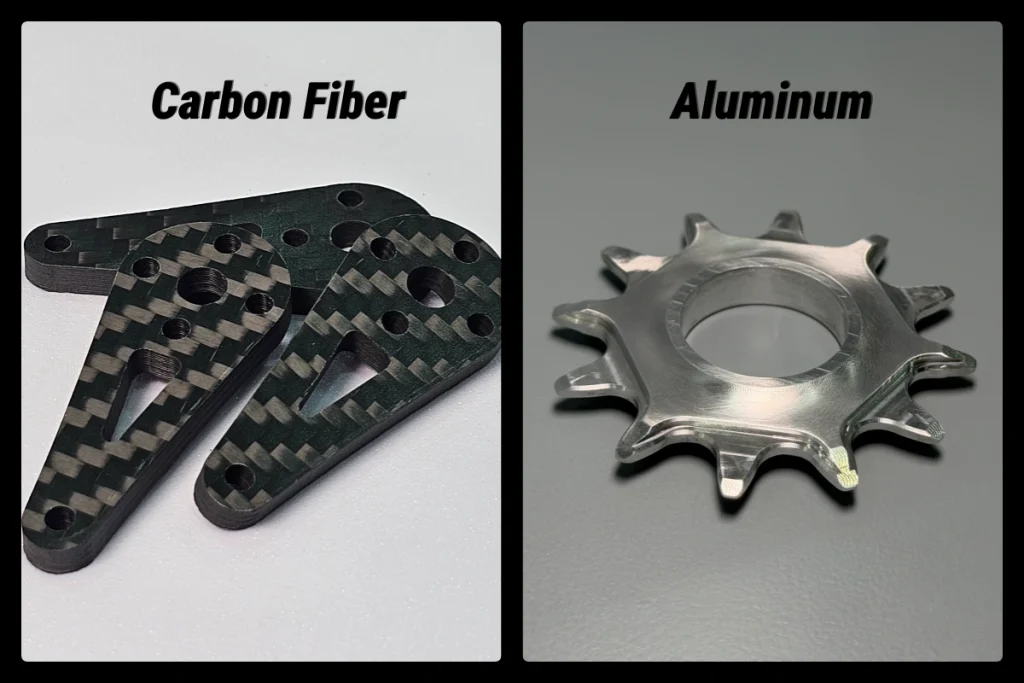
CNC machining commonly processes metals such as aluminum and stainless steel, as well as engineering plastics such as nylon and PEEK. Specialized setups can also machine materials such as carbon-fiber composites and technical ceramics. Injection molding focuses on thermoplastics, with options including ABS, PP, PC, and reinforced grades.
These options offer different levels of stiffness, heat resistance, and wear resistance, allowing material selection to follow the part’s operating requirements.
Complex Geometries, Holes and Undercuts
For CNC, complexity means restricted cutter access, small tool diameters, long tool reach, deep cavities, narrow slots, and difficult workholding. Additional setups or secondary operations may be necessary. Internal corner radii also follow cutter geometry.
For molding, complexity concerns mold-core access, filling, and releasing the part. Parting lines and undercuts may require slides, lifters, or other mechanisms that increase tooling complexity. Neither process wins every complex-part comparison: a feature easy to mold may be expensive to cut, while an apparently simple molded feature may obstruct ejection.
Wall Thickness, Draft Angles and Ribs
Thin CNC-machined walls can deflect or vibrate during cutting. Material stiffness, wall height, tool engagement, and workholding determine the risk, so minimum thickness requires a part-specific assessment.
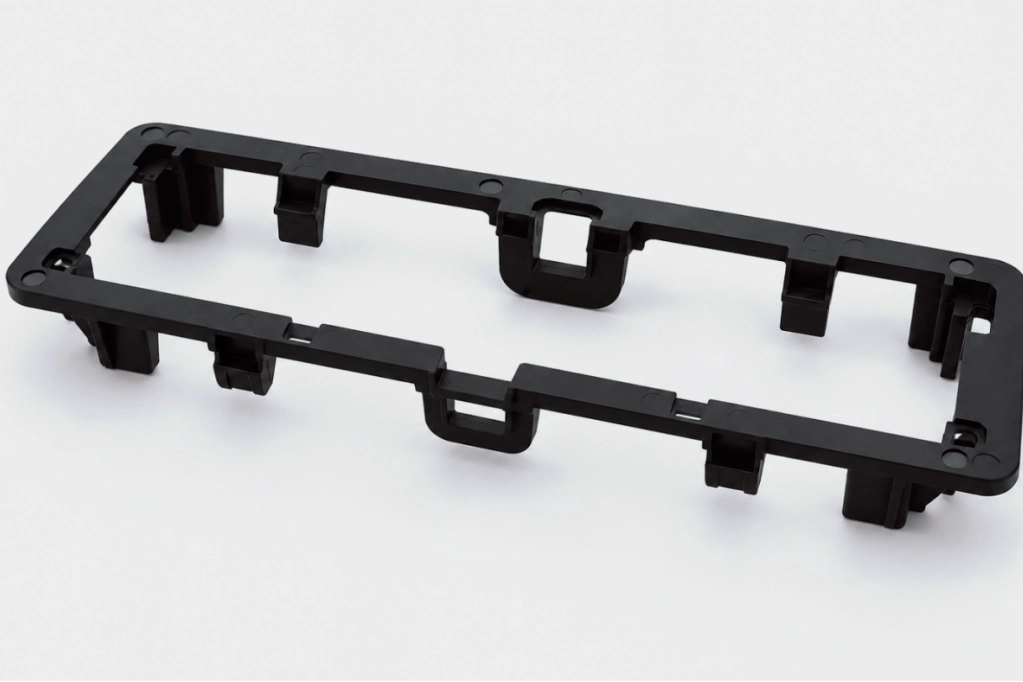
Molded parts generally benefit from reasonably uniform wall thickness and appropriately proportioned ribs and bosses. Abrupt thickness transitions can cause uneven cooling, sink marks, and warpage. Draft angles facilitate ejection, but suitable draft depends on resin, texture, geometry, and tooling.
In a CNC machining vs injection molding design review, assess these constraints before requesting like-for-like prices. A solid machined housing may need hollowed sections, ribs, and draft to become a practical molded component.
Surface Finishes and Dimensional Accuracy
CNC machining surface finish may retain cutting marks. Options include finer machining, bead blasting, polishing, anodizing applicable aluminum alloys, and suitable painting or coating.
Injection molded surface finish primarily reflects cavity polish or texture, producing gloss, matte, or patterned surfaces. Secondary finishing remains possible. Appearance also depends on resin and processing conditions; changing an established molded texture or polish may require additional tool work.
CNC can be advantageous for directly machined precision features and controlled fits. Molded dimensions depend on shrinkage, cooling, tooling, process stability, and fiber orientation where reinforced resins are used.
Identify critical dimensions, datums, cosmetic zones, and inspection requirements during design review. If a molded component needs secondary machining for a critical interface, include that operation in both the cost and scheduling comparison.
When to Choose CNC Machining or Injection Molding
Choose CNC Machining for Prototypes and Low-Volume Parts
CNC machining makes sense when you need working parts but are not ready to commit to tooling. You can check the assembly, test the design, and make changes before the next batch. It is also a practical production option for metal components and small repeat orders.
Choose Injection Molding for Repeat Production
Injection molding is worth considering when you expect to reorder the same part with few design changes. Compare the tooling investment with the savings across realistic order quantities, not just the lowest quoted unit price. Before ordering the mold, agree on the resin, critical dimensions, cosmetic requirements, and sample acceptance criteria.
FastPreci focuses on CNC machining while also supporting injection molding and other common processes. A review of the drawings, order quantities, and delivery requirements helps identify a suitable manufacturing approach.
Use CNC Prototypes Before Committing to a Mold
Use CNC prototypes to resolve fit, mounting, and clearance issues before tooling begins. Then review the design specifically for molding, including wall thickness, ribs, draft, undercuts, and parting lines.
Keep the two approvals separate: a machined prototype can confirm assembly, but molded samples are still needed to verify molding-related dimensions, appearance, and performance.
Frequently Asked Questions
Is CNC machining cheaper than injection molding?
Often for prototypes and small batches, because it avoids dedicated mold tooling. Injection molding can deliver lower recurring unit costs, but the comparison must include tooling, setup, finishing, inspection, and the number of acceptable parts actually required.
At what quantity does injection molding become more cost-effective?
Injection molding becomes more cost-effective when the savings in per-part production costs outweigh the upfront mold investment. For example, if tooling costs $5,000 and molding saves $5 per part compared with CNC machining, the break-even point is approximately 1,000 parts. This simplified estimate excludes setup, finishing, inspection, scrap, and other costs. For a reliable comparison, request pricing at several quantities based on your expected demand.
Can CNC machining be used for plastic parts?
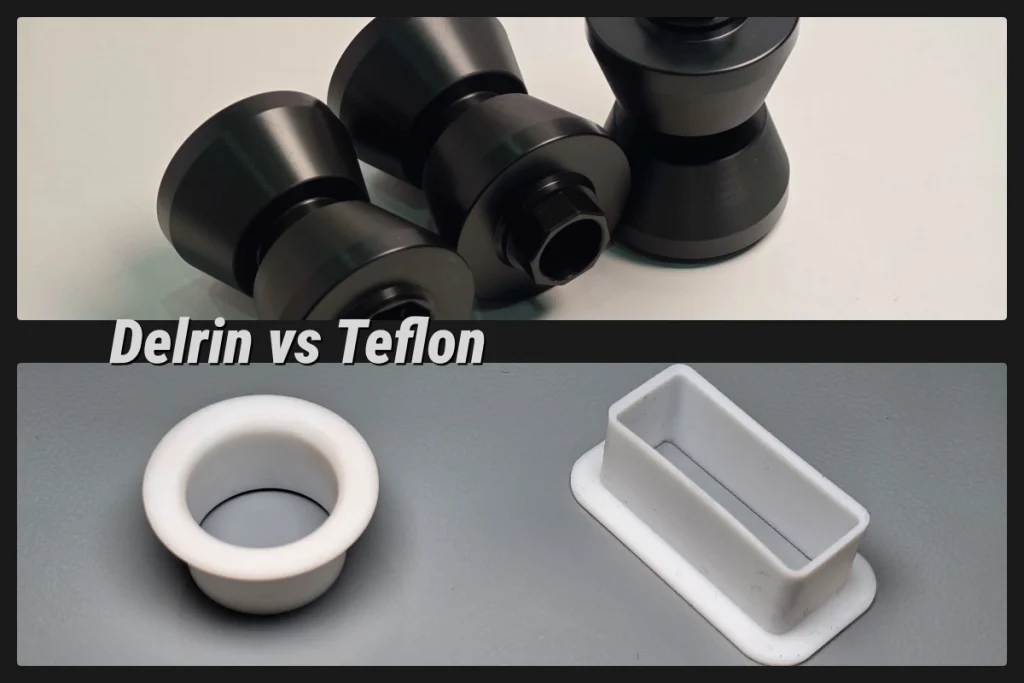
Yes. Many engineering plastics, including POM, nylon, and PEEK, can be machined. CNC machined plastic parts are useful for functional prototypes, controlled interfaces, and small production batches when mold investment is unnecessary or the design remains unsettled.
Can CNC-machined prototypes be converted to injection-molded parts?
Yes, but conversion is not necessarily a direct CAD transfer. A molding-specific DFM review may require changes to walls, ribs, draft, undercuts, and parting lines. Validate molded samples separately because machining does not reproduce molding-related shrinkage and processing effects.