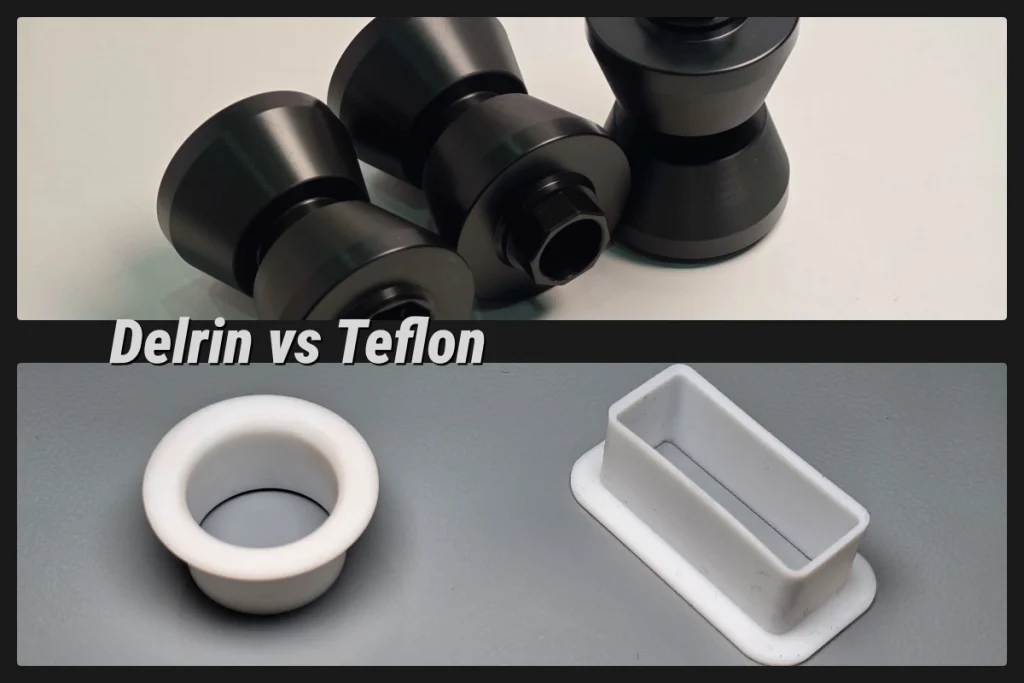
Delrin and Teflon are often compared because both are used in low-friction engineering applications, but they solve different design problems. Delrin, a brand of acetal resin typically referring to POM-H, offers high stiffness, strength, and dimensional stability for precision mechanical parts. Teflon, when referring to machined components, usually means PTFE, a fluoropolymer valued for its very low friction, chemical resistance, and high-temperature capability.
This Delrin vs Teflon comparison helps engineers, designers, and procurement teams choose materials for CNC-machined plastic parts. The property values below are representative examples for specific grades, not universal design limits. Always verify the material grade, operating conditions, and manufacturer’s data before finalizing a specification.
Delrin vs Teflon: Key Differences at a Glance
Delrin is a DuPont brand of acetal resin, commonly associated with POM-H homopolymer grades. Teflon is a Chemours brand family covering multiple fluoropolymer products. This article focuses on PTFE when discussing Teflon for machined components.
| Property | Delrin 100P NC010 (POM-H) | PTFE (Teflon™) |
| Material type | Acetal homopolymer | Polytetrafluoroethylene |
| Tensile properties | Tensile yield stress: 71 MPa; tensile modulus: 2,830 MPa (ISO 527) [1] | Tensile strength: 28 MPa (typical resin data) [2] |
| Flexural modulus | 2,710 MPa (ISO 178) [1] | 496 MPa (ASTM D790; typical resin data) [2] |
| Friction and wear | Low friction; wear performance varies by grade [1] | Very low friction; dynamic coefficient of friction: 0.05–0.10 (ASTM D1894; typical resin data) [2] |
| Chemical resistance | Resistant to many common chemicals; check compatibility with the specific chemical and conditions [1] | Excellent resistance to most industrial chemicals and solvents [2] |
| Temperature capability | Suitable for many mechanical applications; allowable temperature depends on grade and load | High-temperature capability; allowable operating temperature depends on grade, load, and environment |
| Creep and dimensional stability | Generally better suited to rigid, dimensionally stable parts under load | More prone to creep and cold flow under sustained load |
| CNC machinability | Generally well suited to rigid, dimensionally precise parts | Requires careful clamping, heat control, and tolerance planning |
Note: Delrin values are for grade 100P NC010. PTFE figures are typical resin data from Chemours’ Teflon™ product selection guide and may not represent every CNC-machined stock grade. Tensile yield stress and tensile strength are different measurements and should not be compared as equivalent values. Actual properties depend on grade, product form, test method, and operating conditions.
Delrin vs Teflon: Mechanical Properties and Performance
Strength and Stiffness
Delrin is generally much stronger and stiffer than unfilled PTFE. For CNC-machined parts, this difference affects how well a component maintains its shape under load. Delrin is often suitable for gears, cams, bushings, rollers, and locating components that must resist bending or maintain a controlled fit.
PTFE can still be used in load-bearing applications, but its lower stiffness and greater tendency to deform under sustained pressure need to be considered. It is often a better fit when compliance, sealing, chemical resistance, or low-friction contact matters more than structural rigidity.

Friction and Wear Resistance
PTFE is known for its very low coefficient of friction, making it useful for sliding surfaces, seals, and components that need to move against another surface with minimal resistance. Delrin also offers low friction and can provide a useful balance of stiffness, wear performance, and dimensional control in mechanical assemblies.
However, low friction does not automatically mean better wear resistance. Wear depends on contact pressure, sliding speed, temperature, lubrication, surface finish, and the material of the mating component.
For moderately loaded sliding mechanisms, Delrin may provide a better balance of rigidity and wear life. For applications where friction reduction is the main priority, PTFE may be more appropriate. A modified Delrin grade such as Delrin 100AF, which incorporates PTFE fibers, may also be worth evaluating when reduced friction and wear are needed without giving up all the advantages of acetal. Confirm the exact grade formulation and performance data before specifying it.
Chemical and Temperature Resistance
PTFE is often the preferred option for components exposed to aggressive chemicals. Chemours describes its PTFE fluoropolymer resins as resistant to nearly all industrial chemicals and solvents. PTFE offers high-temperature capability, but the allowable operating temperature depends on the specific grade, product form, load, and operating environment.
Delrin performs well in many industrial environments, but it is not chemically universal. Compatibility must be checked for the actual chemical, concentration, temperature, and exposure duration. Strong acids, oxidizing agents, and some other aggressive media may make acetal unsuitable.
Temperature also affects mechanical performance. A material’s maximum service-temperature rating does not mean it can maintain the same strength, stiffness, or dimensional accuracy at that temperature. For load-bearing parts, check the relevant mechanical properties at the intended operating temperature rather than relying on melting temperature alone.
Dimensional Stability and Creep
Dimensional stability is important when a CNC-machined part must maintain a controlled fit over time. Delrin generally offers a useful combination of rigidity, relatively low moisture absorption, and resistance to long-term deformation. Delrin generally offers relatively low moisture absorption and good resistance to deformation under load compared with unfilled PTFE. However, dimensional stability still depends on temperature, geometry, residual stress, and the applied load.
PTFE requires more careful consideration when it is held under continuous pressure. It can gradually deform under sustained compressive or bolted loads, a behavior commonly described as creep or cold flow. The effect becomes particularly important when temperature increases or when a part must maintain a tight fit over a long service life.
This does not make PTFE unsuitable for precision components. It means the design should account for the material’s behavior. PTFE can work well for seals, liners, and insulating components, while Delrin may be a better starting point for rigid spacers, locating features, and load-bearing parts that must retain their geometry.
Low water absorption alone should not be used as proof of dimensional stability. Thermal expansion, residual stress, part geometry, and sustained loading also affect final dimensions.
Common Applications of Delrin vs Teflon
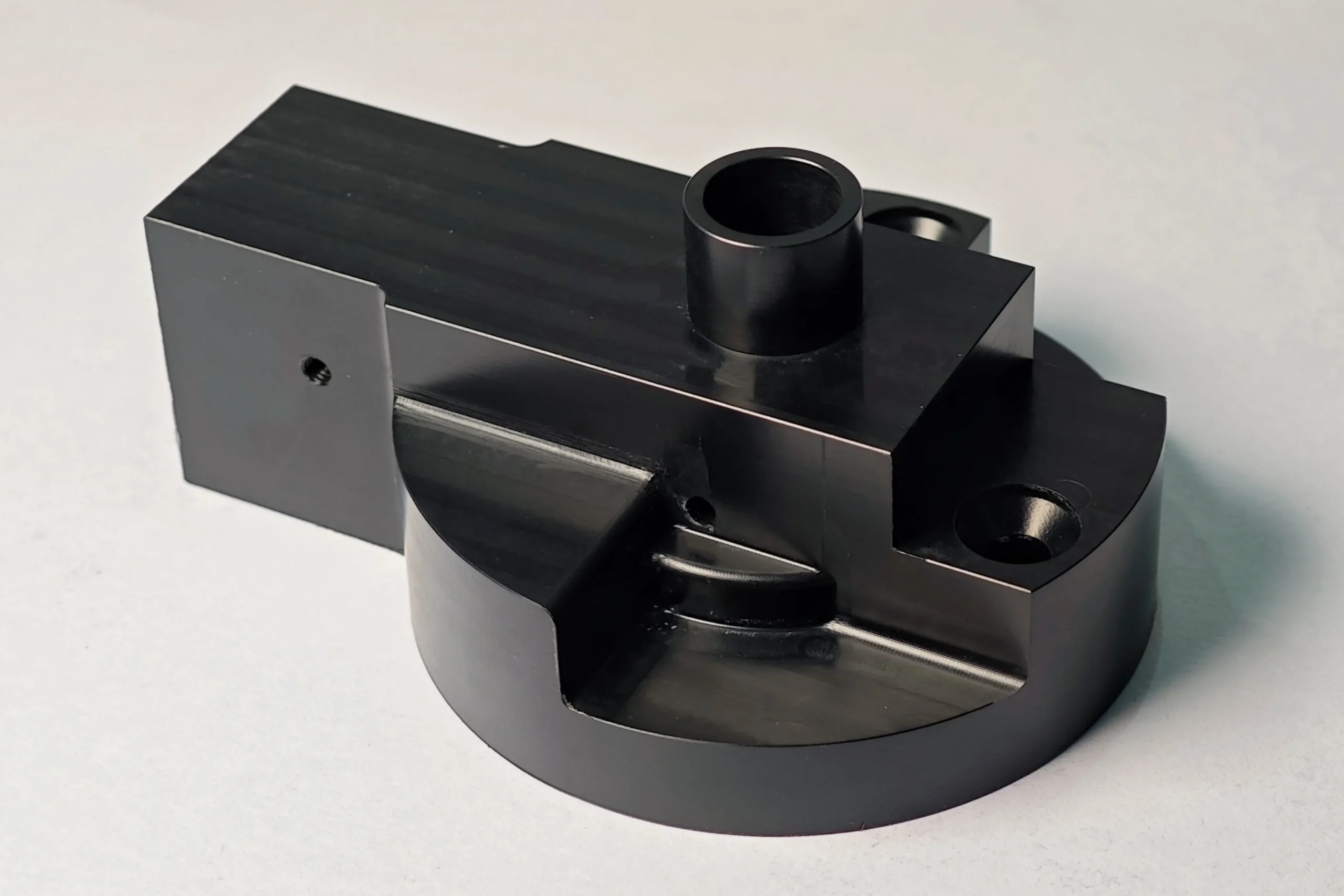
Delrin is commonly used for CNC-machined gears, cams, rollers, bushings, fixtures, snap-fit components, and precision mechanical assemblies. Its stiffness helps functional features maintain their shape, while its low friction and wear performance can suit moving parts. Its limitations include temperature capability and compatibility with certain chemicals.
PTFE is commonly used for seals, gaskets, valve seats, electrical insulators, chemical-processing components, wear pads, and low-friction guide surfaces. It is particularly useful when chemical resistance, electrical insulation, or very low friction is more important than rigidity. Its main limitations include creep, lower stiffness, and greater difficulty maintaining tight tolerances.
Consider a sliding guide in a mechanical assembly. If the guide must retain its geometry under moderate load and maintain a repeatable clearance, Delrin may be the better choice. If a component must resist aggressive chemicals while providing a low-friction contact surface, PTFE may be more appropriate, provided its deformation and dimensional requirements are addressed.
CNC Machining Considerations for Delrin and PTFE
Workholding and Clamping Pressure
Delrin can generally be held securely, but excessive clamping pressure may distort thin walls, long parts, or delicate features. Use soft jaws, broad contact surfaces, or a supporting fixture to distribute the clamping force. For thin or asymmetric parts, consider roughing first, releasing the workpiece, and finishing critical features after the part has stabilized.
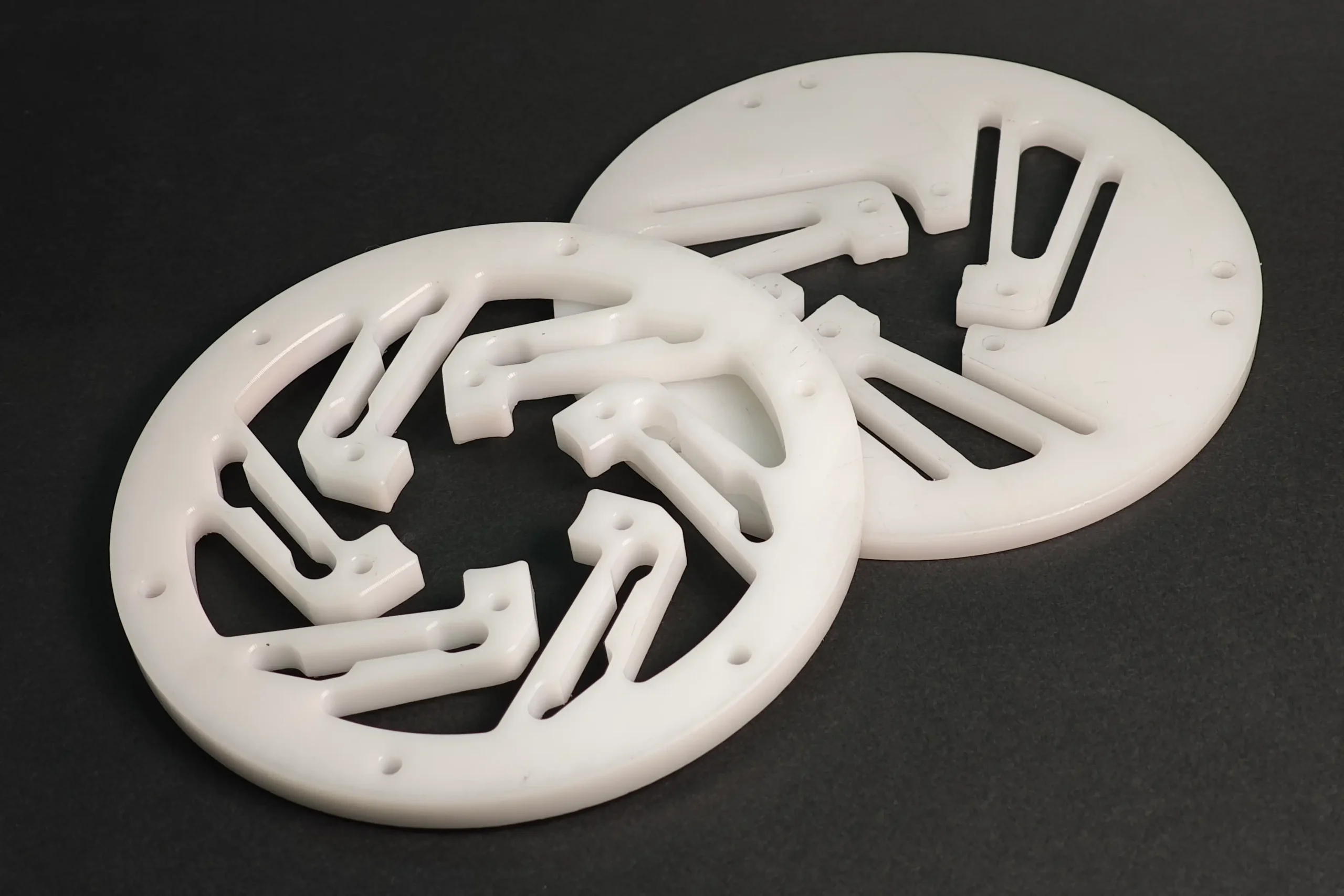
PTFE needs lighter clamping because it is softer and more prone to deformation. Conventional vise pressure can crush, bow, or leave marks on the material. Use padded soft jaws, broad contact areas, and minimal clamping force. Support thin sheets and rings close to the machining area, and consider a suitable mechanical fixture or sacrificial support plate where necessary.
The goal for both materials is to hold the part securely without forcing it into a shape that changes once the fixture is released.
Cutting Heat, Tools, and Chip Evacuation
Delrin generally machines cleanly with sharp tools suitable for plastics. The main concerns are heat buildup, chip packing in deep pockets, and burrs at entry and exit edges. Use sharp cutting edges, avoid excessive rubbing, and clear chips frequently. Air blast or an appropriate coolant strategy may help where needed, provided it is compatible with the material and process.
PTFE’s softness and thermal behavior make cutting conditions especially important. Use sharp carbide tools with suitable geometry for plastic machining, and choose cutting parameters that produce clean chips rather than rubbing or pushing the material. Remove chips continuously, particularly when machining deep features or internal bores, because stringy chips can wrap around the tool or damage the surface.
Avoid unnecessary dwell and repeated spring passes if they create heat or push the material rather than cutting it cleanly. The correct parameters depend on tool geometry, part size, machine rigidity, and the specific PTFE grade, so establish them through controlled trials rather than relying on a universal speed or feed value.
Toolpaths, Stress Relief, and Inspection
For Delrin, a staged machining sequence can help control distortion in parts with deep pockets, asymmetric material removal, or tight flatness requirements. Rough the part first, then finish critical diameters, faces, and bores after the part has stabilized. Where residual stress is likely to affect the geometry, assess whether a suitable stress-relief process or an additional finishing stage is warranted.
For PTFE, minimize heat and mechanical stress throughout the process. Use light finishing passes on critical features, avoid excessive clamping between operations, and check dimensions after the part has cooled and relaxed. The inspection plan should reflect the part’s functional requirements and expected material movement.
If a close fit is essential, evaluate the geometry, material grade, operating temperature, and load together. Depending on the application, a more forgiving clearance, an adjustable mating feature, or a suitable filled PTFE grade may be worth considering.
Tolerances, Surface Finish, and Post-Processing
Specify tight tolerances only where they affect function. Delrin can often be machined to precise dimensions, but thermal expansion, moisture exposure, part geometry, and residual stress still matter. For PTFE, allow for greater material movement and creep when establishing tolerances and clearances. Functional inspection may be more meaningful than applying unnecessarily tight tolerances to every dimension.
Many machined plastic parts do not require additional surface finishing. A machined surface may be sufficient for fixtures, insulators, bushings, and other components, depending on the required surface finish and function.
Polishing or other surface treatments should be considered only when there is a clear performance or appearance requirement. PTFE’s low surface energy makes adhesion difficult, so bonding and coating generally require appropriate surface preparation and process validation.
Delrin vs Teflon: Which Material Should You Choose?
Choose Delrin when the part needs stiffness, strength, dimensional control, or a balance of friction and wear performance. It is often a strong starting point for gears, locating components, bushings, and other precision mechanical parts operating in a compatible environment.
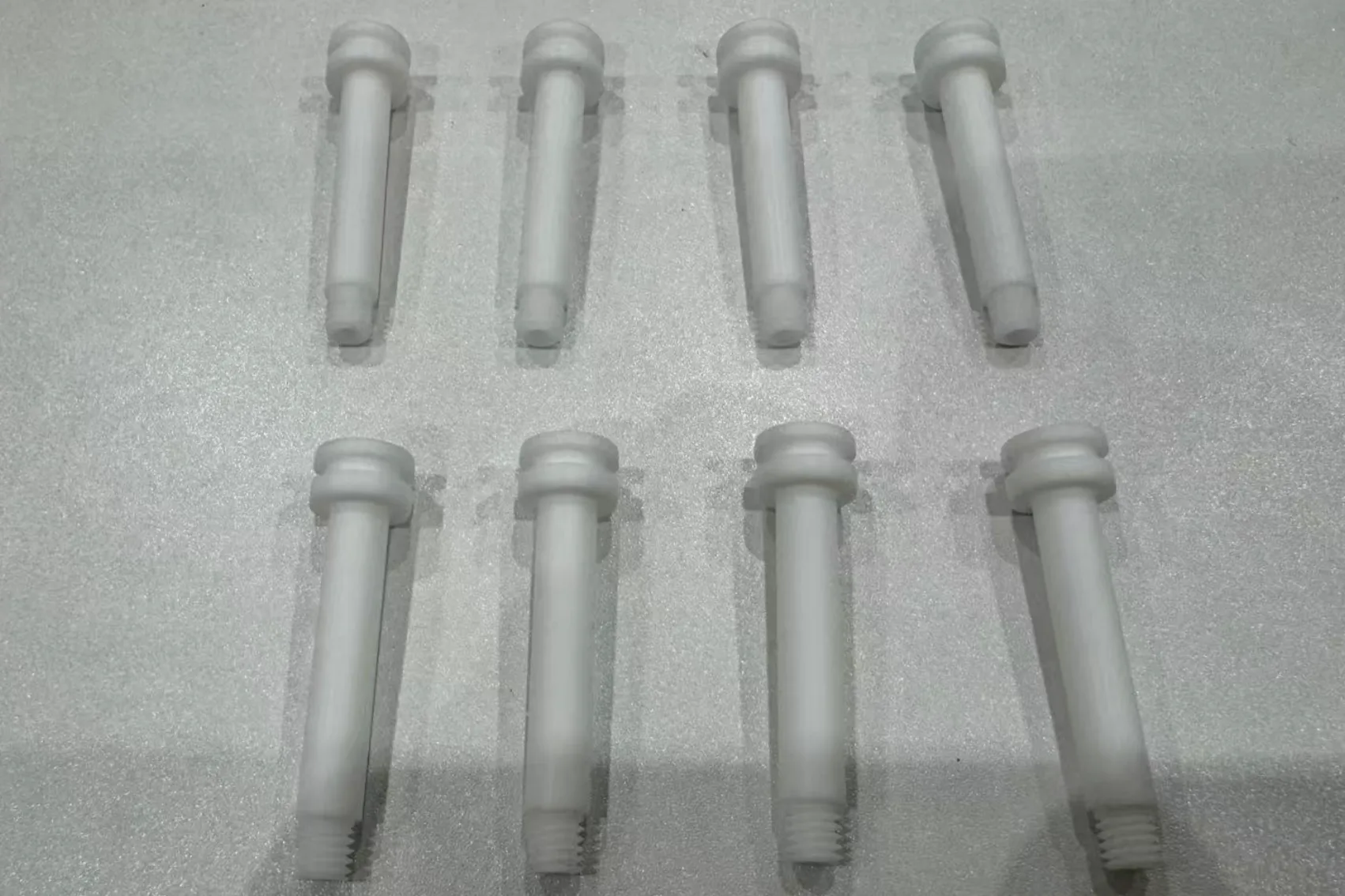
Choose PTFE when chemical resistance, very low friction, electrical insulation, or higher-temperature capability is the main requirement. Account for its tendency to creep under sustained load and its greater difficulty maintaining tight tolerances.
A modified acetal grade may also be worth evaluating when a design needs improved friction or wear behavior while retaining more rigidity than unfilled PTFE. The final decision should be based on the actual grade, load, temperature, chemical exposure, mating surface, and required dimensional accuracy.
Conclusion
Delrin and PTFE serve different engineering priorities: Delrin is generally better suited to rigid, load-bearing precision parts, while PTFE is often preferred for chemical resistance and very low friction. Choosing the material early—and accounting for machining, tolerances, and operating conditions—helps reduce avoidable redesign and performance issues. FastPreci can help assess manufacturing requirements for custom CNC-machined plastic components.
Frequently Asked Questions
Is Teflon stronger than Delrin?
Generally, no. Delrin is substantially stiffer and usually stronger than unfilled PTFE. However, published values must be compared carefully because yield stress, tensile strength, and modulus measure different properties. The right choice also depends on temperature, loading, and the specific material grade.
What is the difference between Delrin and PTFE?
Delrin is a brand of acetal resin, typically POM-H, valued for stiffness, strength, and dimensional control. PTFE is a fluoropolymer known for very low friction, chemical resistance, and high-temperature capability. Teflon is a brand family that includes PTFE and other fluoropolymer products.
Which is better for CNC machining, Delrin or Teflon?
Delrin is generally easier to machine into rigid parts with controlled dimensions. PTFE can also be CNC machined, but its softness and creep require careful clamping, heat management, and tolerance planning. The better choice depends on the part’s functional requirements.
Can PTFE be used for load-bearing parts?
Yes, PTFE can be used in load-bearing applications, but its tendency to creep under sustained pressure needs to be considered. Load, temperature, and loading duration all affect how much the material deforms over time. For parts that must maintain rigidity and dimensional accuracy under continuous load, Delrin is often a better starting point. PTFE may be more suitable when low friction or chemical resistance is the primary requirement.
Can PTFE be CNC machined to tight tolerances?
Yes, but maintaining tight tolerances in PTFE can be more challenging than in Delrin. PTFE is relatively soft and susceptible to deformation during clamping and machining. Thermal expansion and creep can also affect dimensional accuracy. The achievable tolerance depends on part geometry, material grade, dimensions, and operating conditions. For critical features, careful workholding, heat control, and inspection after the part has cooled and stabilized are important.
Is Delrin suitable for chemically aggressive environments?
Delrin resists many common industrial chemicals, but it is not suitable for every chemical environment. Compatibility depends on the chemical, concentration, temperature, and exposure duration. Strong acids, oxidizing agents, and certain other aggressive media may damage acetal. PTFE is generally a stronger candidate when broad chemical resistance is essential, but the specific material grade should still be verified against the intended service conditions.
What Colors Are Available for Delrin and Teflon?
Delrin is commonly available in natural (white to off-white) and black, with other colors depending on the grade and supplier. PTFE is typically available in white or natural, while black and other colors may be offered in certain grades or formulations. If color matching is important for your project, confirm the available options before ordering.
How Much Do Delrin and Teflon Cost?
Delrin is usually the more cost-effective option, especially for standard natural or black rod and sheet stock. PTFE typically costs more because of higher raw-material and processing costs, while filled PTFE grades are usually more expensive than virgin PTFE.
As a rough market-based guide, virgin PTFE stock can cost roughly 2–3 times as much as standard Delrin, though the ratio varies with grade, size, quantity, supplier, and region. For accurate budgeting, request a quote based on the part drawing, material grade, quantity, and required tolerances.
References
[1] Delrin®. Design Guide—Module III. Official design guide for Delrin acetal resin grades.
https://www.delrin.com/delrin-design-guide-mod-3
[2] Chemours. Teflon™ Product Selection Guide.
https://www.teflon.com/en/products/product-selection-guide