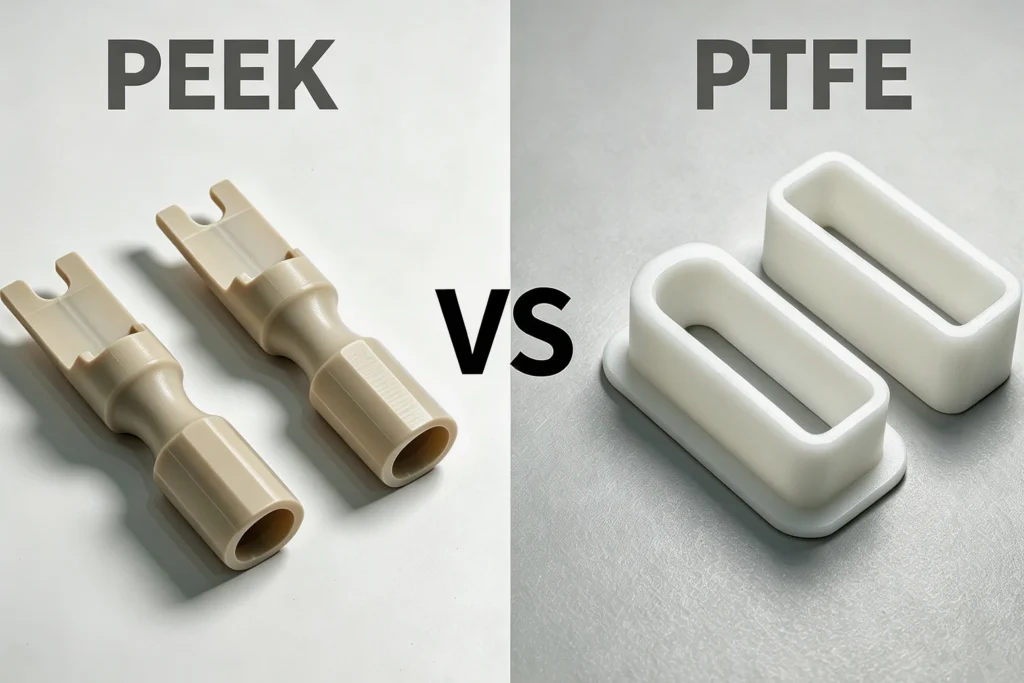
For most plastic machining decisions, PEEK is the better choice when a machined part must carry load, resist creep, hold a precise shape, or maintain functional clearances over time. PTFE is usually the better choice when extremely low friction, broad chemical resistance, low surface energy, or sealing behavior matters more than stiffness and structural load capacity.
The practical PEEK vs PTFE decision is not about which polymer has the better datasheet. It is about whether the part must retain sealing force, bearing clearance, thread engagement, flatness, or alignment under its real combination of temperature, load, chemicals, and motion.
PEEK vs PTFE: Key Differences at a Glance
PEEK and PTFE have different performance strengths. The values below are representative examples for unfilled grades and should be used for comparison rather than as universal design limits.
| Property | PEEK | PTFE | Why It Matters |
| Tensile strength | ~98 MPa* | ~22 MPa* | Indicates load-bearing capability |
| Tensile modulus | ~4.0 GPa* | Much lower | Affects rigidity and deformation |
| Density | ~1.30 g/cm³* | ~2.15 g/cm³* | Affects component weight |
| Continuous-use temperature | High-temperature capable | Up to ~260°C* | Defines usable service range |
| Coefficient of thermal expansion | Lower | Higher | Affects dimensional stability |
| Friction | Low | Very low | Important for sliding and sealing |
| Creep resistance | Generally better | Generally lower | Affects long-term dimensional stability |
*Representative values; actual properties depend on material grade and test conditions.
PEEK generally offers higher strength, stiffness, and dimensional stability, making it suitable for precision components that must retain their geometry under mechanical load. PTFE has lower mechanical strength but provides extremely low friction, broad chemical resistance, and low surface energy.
The numerical difference in thermal expansion is also important for precision parts. PTFE’s higher thermal expansion can make temperature control and dimensional compensation more important when tight clearances or sealing dimensions are involved.

PEEK vs PTFE: Strength, Temperature, and Chemical Resistance
PEEK has a clear mechanical advantage when a part must resist deflection or maintain its geometry. Higher stiffness matters when a component supports a load, keeps a shaft aligned, holds an interference fit, or maintains a controlled gap between moving parts.
For example, a loaded bushing or precision fixture may benefit from PEEK because the material is better able to maintain bearing geometry under sustained contact pressure. One recent job is written up in our PEEK CNC machining case study.
PTFE may initially fit the same drawing dimensions, but its greater compliance can become limiting if the part must resist compression, flattening, or distortion in service.
Temperature capability requires a more careful comparison. Both PEEK and PTFE can be used in demanding thermal environments, and their published continuous-service ranges may overlap depending on the material grade and supplier guidance. The key question is not simply, “Which material has the higher maximum temperature?”
A more useful question is: What load must the part carry at that temperature?
PEEK is often favored where elevated temperature is combined with meaningful mechanical load, tight functional clearances, or structural requirements. PTFE can also perform well at high temperature, particularly in seals, chemical-processing parts, and low-load sliding applications. However, its lower stiffness and greater tendency to deform become more important as temperature and sustained stress increase. For grade-by-grade machining behavior, see our PEEK CNC machining guide.
For PEEK vs PTFE chemical resistance, PTFE generally has the broader advantage. It is widely used in corrosive chemical service because of its highly inert fluoropolymer structure and low tendency to react with many process media.
PEEK also offers excellent resistance to many oils, fuels, hydrocarbons, and industrial fluids. But PEEK should not be treated as chemically equivalent to PTFE in every environment. Strong oxidizing chemicals, highly concentrated acids, elevated temperatures, pressure, and long-term immersion can change the result. Material compatibility should be checked against the actual chemical, concentration, temperature, and exposure duration.
PEEK vs PTFE: Friction, Wear, and Creep
PTFE is well known for extremely low friction. That makes it attractive for sliding components, seal lips, valve seats, liners, and surfaces where low breakaway force or low stick-slip behavior is useful.
However, PEEK vs PTFE friction is not a complete answer to a bearing or bushing design problem. Friction depends on contact pressure, sliding speed, temperature, lubrication, counterface material, surface finish, contamination, and the polymer grade. PTFE can form a transfer film on a mating surface during dry sliding, which may help reduce friction but can also change wear behavior.
PTFE’s low friction does not automatically make it the best option for every sliding part. Virgin PTFE can deform or wear relatively quickly when contact pressure, speed, or temperature becomes demanding. Filled PTFE grades may improve wear resistance, stiffness, and creep resistance, but fillers can also change machinability, electrical behavior, chemical performance, and surface characteristics.
PEEK is often selected for loaded bushings, bearing components, and wear parts because it can maintain contact geometry more effectively under mechanical load. That does not mean unfilled PEEK is always the best tribological option. Filled PEEK grades may be more appropriate when dry-running behavior, friction, or wear resistance is critical.
Creep is time-dependent deformation under sustained stress. In a clamped PTFE ring, loaded bushing, or press-fit component, creep can gradually change the part’s shape and affect sealing force, interference, or running clearance. Stress relaxation is closely related: when a polymer is held in compression, the force it exerts can decrease over time.
This distinction matters in seals and fastened assemblies. PTFE may provide excellent chemical compatibility and low friction, but the design may need a larger contact area, a filled grade, mechanical support, a backup ring, or another feature that manages long-term deformation.

PEEK vs PTFE Manufacturing Methods
PEEK and PTFE can both be made into precision components, but they are not processed in the same way. PEEK is a high-performance thermoplastic that can be machined, injection molded, extruded, and processed with specialized additive manufacturing equipment. Conventional PTFE has extremely high melt viscosity, so it is typically shaped through compression molding, extrusion, or other molding methods followed by sintering rather than conventional injection molding.
| Manufacturing Method | PEEK | PTFE | Key Consideration |
| CNC Machining | Excellent | Good | PEEK generally offers better rigidity and dimensional control; PTFE requires more attention to deformation and thermal expansion |
| Injection Molding | Excellent | Generally not suitable | PEEK can be melt-processed; conventional PTFE is not suited to conventional injection molding |
| Compression Molding | Possible | Excellent | Particularly established for PTFE and followed by sintering |
| Extrusion | Excellent | Excellent | Commonly used to produce rods, tubes, profiles, and other semi-finished forms |
| Sintering | Not typically required | Essential in conventional processing | PTFE is commonly sintered after molding or extrusion |
| 3D Printing | Possible with specialized equipment | Limited | PEEK requires high-temperature additive manufacturing; conventional PTFE is difficult to process by standard 3D printing |
| Vacuum Casting | Not a conventional process | Not a conventional process | Neither material is normally selected for vacuum casting |
PEEK vs PTFE for CNC Machining
Both PEEK and PTFE can be CNC machined, but their machining behavior is different. PEEK is generally better suited to precision components that require rigidity, stable holes and threads, controlled mating surfaces, or relatively tight functional tolerances. Its higher stiffness can help reduce deformation during clamping and machining.
PTFE can also be machined into complex parts, but its lower stiffness, greater thermal expansion, and tendency to deform under clamping or cutting forces make close-tolerance work more challenging. Critical diameters, sealing grooves, thin walls, and threads may require additional support and process control.
For either material, the machining strategy should account for the material grade, part geometry, wall thickness, tolerance requirements, and production quantity. For demanding plastic components, workholding, machining sequence, temperature control, and inspection conditions can all affect the final dimensional result. The clamping and inspection practice behind those numbers is covered in our PTFE machining guide.
PEEK vs PTFE for Injection Molding
PEEK is compatible with injection molding and is used for producing complex, repeatable components at higher production volumes. However, its high processing temperatures require suitable molding equipment, tooling, material drying, and process control. Injection molding can become attractive when the tooling investment is justified by the production quantity.
Conventional PTFE is fundamentally different. Although PTFE is a fluoropolymer, it has extremely high melt viscosity and does not flow like conventional thermoplastics during injection molding. Instead, PTFE components are commonly formed through compression molding, isostatic molding, or extrusion and then sintered.
This difference is important when selecting a production method: PEEK offers more conventional thermoplastic processing options, while PTFE relies more heavily on specialized molding and sintering routes.

PEEK vs PTFE: Common Applications
The application itself does not determine the material. The better choice depends on the combination of load, temperature, chemicals, friction, and dimensional requirements.
| Application | Usually Favored | Main Reason |
| High-load bushings | PEEK | Higher stiffness, strength, and creep resistance |
| Precision fixtures | PEEK | Better dimensional stability and rigidity |
| Structural or semi-structural components | PEEK | Better performance under mechanical load |
| Precision insulators | PEEK | Mechanical strength combined with electrical performance |
| Chemical seals | PTFE | Broad chemical resistance and low friction |
| Valve seats | PTFE | Low friction, chemical resistance, and sealing behavior |
| Low-load sliding liners | PTFE | Very low friction and low surface energy |
| Chemical-processing components | PTFE | Excellent resistance to many aggressive chemicals |
| Medical components | Depends on application | PEEK suits load-bearing components; PTFE/ePTFE suits specific sealing or soft-tissue applications |
PEEK is often preferred when a component must maintain strength, stiffness, alignment, or dimensional stability during service. PTFE is more attractive when low friction, chemical resistance, sealing, or non-stick behavior is the primary requirement.
When Should You Choose PEEK or PTFE?
These guidelines apply to typical material behavior. The final decision should still be based on the selected grade and actual service conditions.
Choose PEEK when:
- The part carries significant mechanical load.
- Higher strength and stiffness are required.
- Creep resistance matters under sustained compression or contact pressure.
- Tight functional tolerances or stable clearances are required.
- The part must retain shape at elevated temperature while loaded.
- Wear occurs under meaningful mechanical load.
- A machined component needs stable holes, threads, flats, or mating features.
- The higher material cost is justified by longer life, reduced deformation, or lower failure risk.
Choose PTFE when:
- Extremely low friction is the priority.
- Broad chemical resistance is critical.
- Non-stick or low-surface-energy behavior is useful.
- The part functions primarily as a seal, liner, valve seat, or low-load sliding component.
- Mechanical loads are relatively low or the geometry provides sufficient support.
- Electrical insulation and chemical inertness are more important than structural stiffness.
- The selected filled or virgin grade meets the application’s deformation and wear requirements.

How to Choose PEEK or PTFE for Your Part?
A reliable PEEK vs PTFE decision evaluates the full operating condition rather than one isolated property.
- Operating temperature: Consider continuous temperature, thermal cycling, local heat generation, and whether the component is loaded while hot.
- Mechanical load: Evaluate compression, bending, impact, fastening load, contact pressure, and cyclic stress.
- Chemical exposure: Confirm compatibility with the actual fluid, concentration, temperature, pressure, and exposure duration.
- Friction and wear: Define sliding speed, contact pressure, lubrication, mating material, and counterface surface finish.
- Dimensional tolerance and stability: Consider thermal expansion, creep, stress relaxation, wall thickness, threads, sealing geometry, and critical clearances.
- Material grade: Decide whether virgin, glass-filled, carbon-filled, mineral-filled, or bearing-grade material is required.
- Production quantity and cost: Compare not only stock cost, but machining complexity, inspection effort, scrap risk, service life, replacement cost, and consequences of failure.
PEEK is generally the better choice when a machined plastic component must stay strong, rigid, and dimensionally stable under load. PTFE is generally the better choice when low friction, chemical resistance, non-stick behavior, or sealing performance dominates the application.
Have a PEEK or PTFE part to manufacture? Send FastPreci your drawing or CAD file for a DFM review.
PEEK vs PTFE FAQs
Is PEEK better than PTFE?
Neither material is universally better. PEEK is generally the better choice for load-bearing, rigid, close-tolerance components where creep resistance and dimensional stability matter. PTFE is usually preferred when extremely low friction, chemical resistance, low surface energy, or sealing performance is more important than structural strength.
Is PEEK more expensive than PTFE?
Yes, PEEK is generally more expensive than standard PTFE, both as a raw material and often as a machined component. However, material price alone should not determine the choice. PEEK may provide longer service life or better dimensional stability in demanding applications, while PTFE can be more cost-effective for seals, liners, and low-load sliding components.
How do PEEK and PTFE perform in high-temperature environments?
Both materials can operate at elevated temperatures, but they behave differently under load. PEEK generally retains much higher mechanical strength and stiffness when temperature and mechanical loading are combined. PTFE can perform very well in high-temperature sealing and chemical applications, but its lower stiffness and greater deformation under sustained load need to be considered.
Which material is better for medical implants—PEEK or PTFE?
It depends on the type of implant and its functional requirements. PEEK is widely used for load-bearing or structural medical components because of its strength, stiffness, chemical resistance, and sterilization capability. PTFE and expanded PTFE (ePTFE) are used in specific medical applications where flexibility, chemical inertness, low friction, or tissue-interface behavior is more important. The appropriate choice must be based on the specific implant design, grade, regulatory requirements, and biological environment.
Can PEEK replace PTFE in sealing applications?
Not always. PEEK can be used in some sealing applications where higher strength, stiffness, wear resistance, or dimensional stability is required, but it does not provide the same combination of very low friction and flexibility as PTFE. If a seal primarily requires chemical resistance, low friction, or conformability, PTFE may remain the better choice. The sealing pressure, temperature, mating surface, chemical exposure, and required service life should all be evaluated before changing materials.
What Are the Common Colors of PEEK and PTFE?
Natural PEEK is typically beige or light tan, while black PEEK is also widely available. Virgin PTFE is usually white or milky white, while black PTFE is commonly used for filled or compounded grades. Color can be important for appearance or part identification, but it should not be used alone to identify a material grade or predict performance. Always confirm the specific grade and its properties with the material supplier or manufacturer.